
8/23 UPDATE: Sef has posted his response, which is worth a read.
Georgia van Raalte, whose firebrand accusations launched a cottage industry of outrage wagons against the established orders within Thelema, just revealed that the rape allegations that started them all were a lie.
Then the unnamed partner in her story revealed who he was and submitted his response. (This gets hilarious, I’ll get to it.)
Normally, I don’t speak about this type of drama and crap. But, as I was dogpiled on five years ago for not believing the narrative that Georgia just admitted was false, I have to say something.
I’m not going to recount the whole story, you can read their versions above, but this is a lesson many can learn from. I’ll aim for two goals here; how do we not fall for misinformation like this, and what do we do if we have?
Redress
The second part is the simplest, but I won’t tell you it is easy. You must admit, as publicly as you broadcast the misinformation, that you were wrong. Ouch, right? A little humbling of the ego, but do this, and I guarantee you will see the results of growth and maturity within you. Humans make errors, and learning from those errors is how we grow. The largely consequence-free environment of online discourse is somewhat responsible for this stunting of growth across all who are terminally online. Don’t go with this flow; even dead fish can do that.
This is the art of redress, to set right a previous wrong. Those who appreciate etymology may notice that the 19th-century ethic also had a synonym as “adjustment” in some uses. This actionable ethic does carry a magical tone, something to think about while you act on it.
It’s time to grow and act like adults. A few have begun this process already.
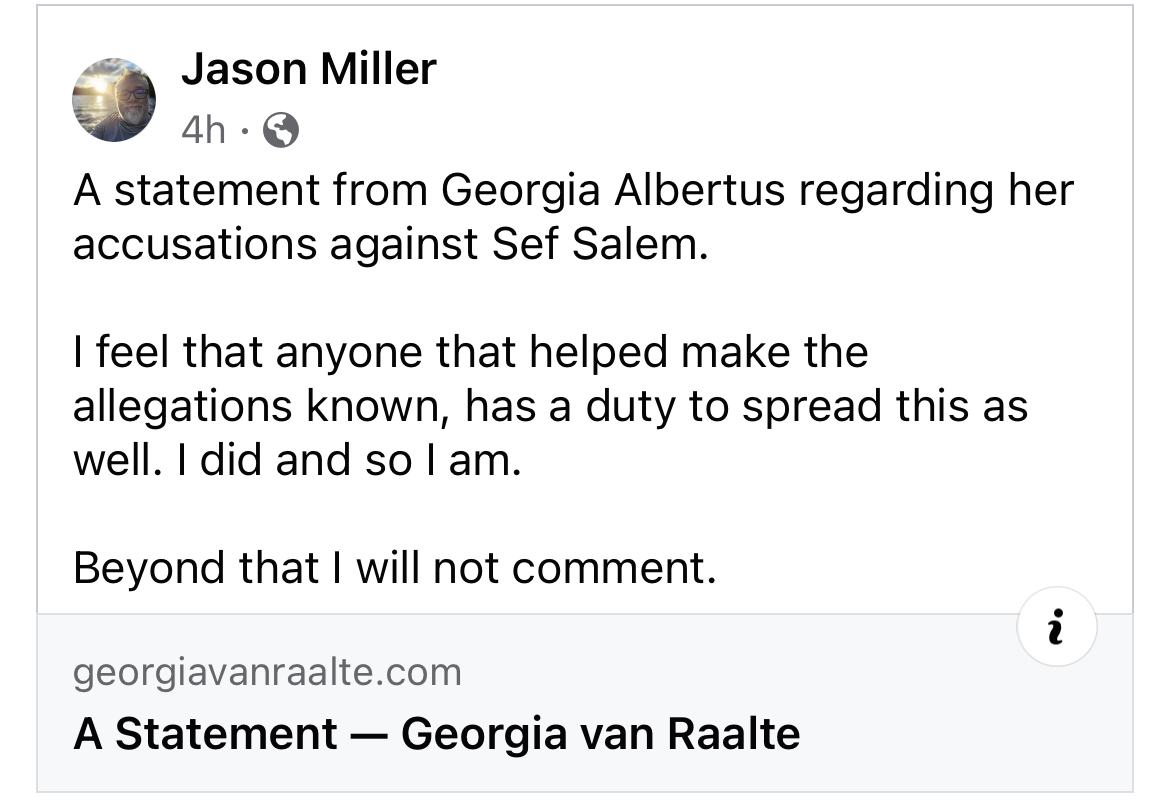
There, that is simple but not easy. Offering apologies as public as your accusations were are the next step. Challenging as well, yes, but not complex. Even if you don’t like those individuals for other reasons, you owe them an apology for this one. Remember, make it just as public as your accusations were.
Caution contra Cynicism
The next step is learning from this mistake. While training (outsourced) anti-fraud agents, I faced a dilemma. There is no way to train someone to fight fraud without teaching them fraud. The solution? Let them know from the start. We are dealing with propaganda and manipulation, so here are some tips.
Two manipulative techniques are relevant to the history of these events and the responses given above. (I told you I’d get back to this.)
The first red flag was, and is, the use of DARVO. This once-hidden manipulation technique has been getting much more attention recently, with certain regressive politicians using it to great effect. DARVO stands for Deny, Accuse, Reverse Victim, and Offend. The order can be switched around; for example, Marco Visconti ends his response with a classic example of a reverse victim. I honestly couldn’t ask for a better way to demonstrate these concepts. His cynicism about #metoo and believing women walks very close to the offensive line. The entire point of his response is a denial, interwoven with attacks on Georgia and accusing her of somehow being in league with the very order she has been bashing for years. I told you this is hilarious. If you want a pronounced example of DARVO, reread his response. Then train yourself on Georgia’s earlier essays and Marco’s eye-rolling tell-alls. Both of them use this technique over and over to make people sympathize and believe their fiction.
The second red flag came from a principle known as Cui Bono, Latin for, who benefits? This is another simple in theory but complicated in practice art. I first learned this trick while active as a Satanist. Anton LaVey used it to figure out where the power lies within any narrative. Aside from the dumpster fire LaVey(ans) can be, this was an excellent trick to learn. I questioned the narrative as false from the beginning because nearly every discussion about this incident was also paired with promotion. Both Georgia and Marco built careers off this outrage. Everything seemed like an ad campaign, so caution and doubt set into my mind. It turns out I was right to mistrust. Take a few breaths with any outrage-inducing post and consider who benefits from publishing this info? Elevating emotions to interfere with rational thinking is a classic con artist trick (think about how Karens work on customer service,) so beware when a story makes you really feel emotional, you may be falling into someone else’s payday.
The other balancing act, or adjustment, I had to teach agents was not to see everything through fraud-colored lenses. This is the safeguard against cynicism. Here it’s not as easy as citing statistics about fraud on the platforms they worked for. I have no significant data sets to crunch about online narratives, but you don’t want to go so far as not to believe anyone ever again. A good example of falling into cynicism is Marco’s response essay (again), where he reveals his lack of trust when people tell him their stories of abuse. However, he expects people to believe him without proof… for years.
Georgia on My Mind
She’s probably heard the reference a million times.
During the pandemic, I haven’t thought about these events at all. Someone recently mentioned Georgia (Albertus) van Raalte in a Discord when talking about Babalon, and I thought, “She is still around?”
I know people are mad at her for the damage she has done, the lies that fooled so many, and even other things. Hell, she roasted a friend of mine as a “non-academic” at an academic conference even though he has multiple post-graduate degrees, and his day job is editing pedagogical material for academia! He went overtime for his presentation, which somehow made him a patriarchal misogynist as well. She also led the charge against a friend of mine’s self-portrait that was used for the cover of Agape, and my friend left social media after the harassment Georgia spearheaded because my friend was expecting a child and had better things to occupy herself with! So while not nearly as horrible as the accusations she just owned up to, there are some people I know that she hurt via lies and outrage porn to build a following. Again, I’m writing this as I’m closer to those hurt by her than many know.
No doubt, Georgia has a lot more terrible behavior to atone for.
But…
Admitting a lie this big takes courage. A huge amount of courage, as Georgia knows people would be justified canceling her as she asked for so many others to be. She is putting a lot of herself on the line to clear the air and admit her wrong. To begin the process of redress for the harm she has caused. Full redress will take much more than a simple statement, but it’s a significant start.
I do not doubt that Georgia has been doing tons of self-work and growth to arrive at this point. That itself is commendable to a degree, and if this is the case, I want to encourage her and others with that work. Will it fix everything? Probably not. Will everyone involved be able to grow and heal somewhat? Certainly.
So that’s why I’m writing all this. We can sit here, and mud sling like internet discussions usually do, or we can grow and learn. An example has been set. We can certainly ask for more or better examples, but we have this one. Over time I’m sure more will come out, and more attempts at redress will be made.
So let’s buck the drama narrative and adjust our positions to something more balanced. Something open enough to allow the Hygeia to flow with enough cautionary structure to accomplish the intended goal—the ever-present goals of growth and healing.
If you want a few books on social manipulation (lesser magic, con-artistry, social engineering, etc.) to help you guard against it, I’ll leave you with a few of my favorites that are also cautious enough for public consideration.
- The Right Way to Do Wrong – An Expose of Successful Criminals by Harry Houdini
- The Art of Deception: An Introduction to Critical Thinking by Nicholas Capaldi
- Any decent Marketing and Advertising book (once you see, you can’t unsee this stuff)

 Ophiphos